Marking Gears: What Survives Heat Treatment, Sandblasting, and Phosphating?
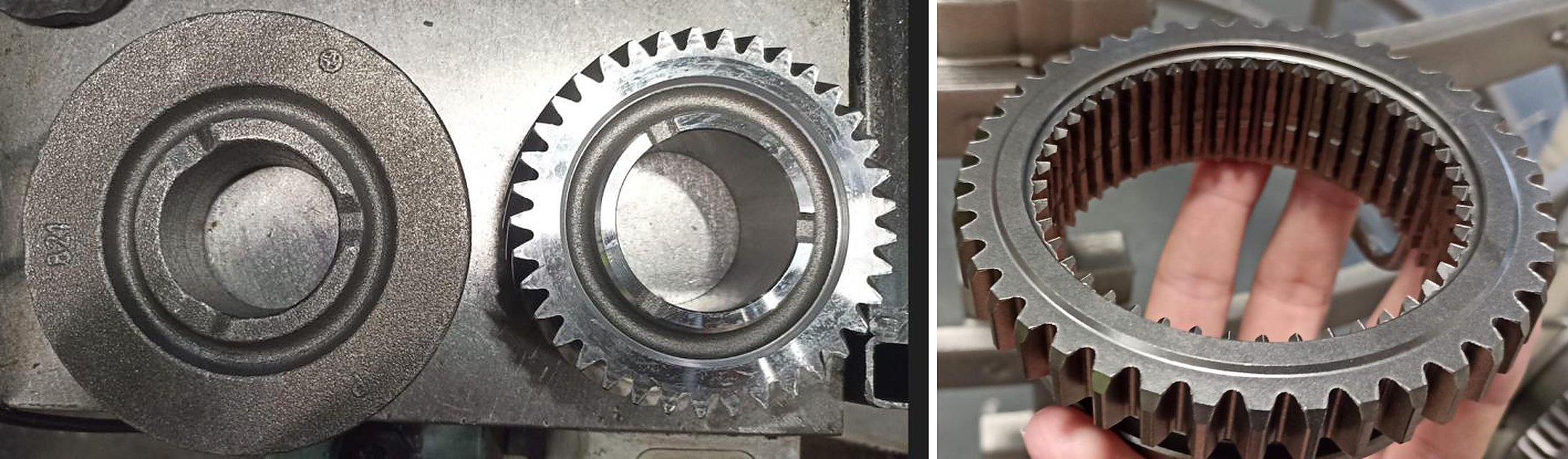
- Between machining and gearbox assembly, a transmission gear passes through heat treatment, sandblasting, and phosphating. Each of the three changes the surface in a different way: heat treatment changes its chemistry and color, blasting removes material from it, and the phosphate coating covers what remains.
- That chain is why part-level traceability on gears commonly breaks after machining: the Data Matrix codes used for identification may not come through it — and the identity worth carrying, which line cut the gear, on which day, as which part of the sequence, exists only at machining and cannot be reconstructed later.
- At a powertrain customer’s plant, laser-applied CDOT Codes go through the full chain — heat treatment, sandblasting, phosphating — and read at every step: applied on the machined face within a 4-second marking cycle, and read with Cognex vision cameras and with standard phones.
- The mark survives because decoding reads a frequency-domain signal engraved into the surface topography rather than classifying light and dark cells; the heat tint, the blasted texture, and the phosphate layer change how the surface looks, not the signal the decoder measures.
A transmission gear is machined, marked, and then sent into the processes that give it its working surface: heat treatment for hardness, sandblasting to clean the surface, phosphating for corrosion and wear protection. The part that comes out is the one that goes into the gearbox — and on most lines, it comes out anonymous, because the identity applied at machining did not survive the trip. This article walks through why gear makers want each part identified from machining onward, what the three finishing processes physically do to a mark, and how marks designed for this environment come through a powertrain customer’s own line reading at every step.
Why Gear Makers Mark at Machining
A gear’s identity is created at machining: a specific line cut it, on a specific day, as a specific number in that day’s sequence, and the machines, tools, and measurements of that operation are recorded against it. Automotive practice is to carry exactly that record in a compact code lasered onto the part — in the line documented below, a 14-character identity holding the part reference, plant, line, year, day, and the part’s number of the day. None of it can be reconstructed afterward: a mark applied at the end of the line can name the finished part, but the link back to the machining data is then made by batch and paperwork, not by the part itself.
Gear manufacturers invest in this identity because of what it lets them do at every later step. Heat treatment is a batch process: parts from more than one machining line travel through the furnace together in containers, and without a readable mark on each part, which furnace load an individual gear went through is known only from the container’s records, not from the part itself. The identity is read again at gearbox assembly, the last step of the chain. And when a quality question arrives — a field return, a customer 8D, a process shift — the manufacturers that answer fastest are the ones that can pull a single part’s record and enumerate exactly which parts are affected. Gear makers such as VCST describe the practice in these terms themselves: a unique, permanent identity on each gear, scanned at key process steps, so that process data, root-cause analysis, and change control attach to parts rather than batches. Automotive quality management points the same way: IATF 16949 requires products to be identified and traceable through production, and customer-specific requirements can extend that to the individual part.
Hardening, blasting, and coating transform the very surface the code lives on, and a cell-based code is read by measuring the optical contrast between its dark and light cells — the property those processes degrade first (our Data Matrix guide covers the verification parameters involved). The result on many transmission lines is a gap: identity exists from machining to the furnace, and again from final inspection onward if the part is re-marked, but the part-level thread through the middle is gone. The powertrain manufacturer in the case below reached the same conclusion in its own evaluation: traceability information from machining goes missing because Data Matrix codes may not withstand its sandblasting, heat treatment, and phosphating chain.
What Heat Treatment, Sandblasting, and Phosphating Do to a Mark
The three processes fail a mark in three different ways.
Heat treatment hardens the gear by heating it to transformation temperature and cooling it under control. For the surface, that cycle may mean oxide growth and color change: the bright machined face goes in, and a darker, tinted surface comes out. A code that depends on the contrast between laser-darkened cells and bright metal background loses that background.
Sandblasting exists to remove surface layers — scale, residue, contamination — by abrading them away, and it does not distinguish between the layer it is meant to remove and the surface detail a mark depends on. Identification that lives in the outermost surface leaves with the blast media; the same applies to shot blasting and other abrasive cleaning.
Phosphating then converts the cleaned surface into a crystalline phosphate layer for corrosion and wear protection. It is a coating: it covers the surface uniformly, mutes contrast, and fills fine detail. A mark that survived the furnace and the blast still has to be read through this layer.
Run in sequence, the three form a filter that very little identification survives: the furnace takes the contrast, the blast takes the surface, and the coating covers what is left. The broader logic of choosing an identifier that outlives its processes is in our durable unique identifier guide; the same filter in a steel mill setting — furnace scale instead of blast media — is documented in our steel pipe article.
Field Results: One Mark Through the Whole Chain
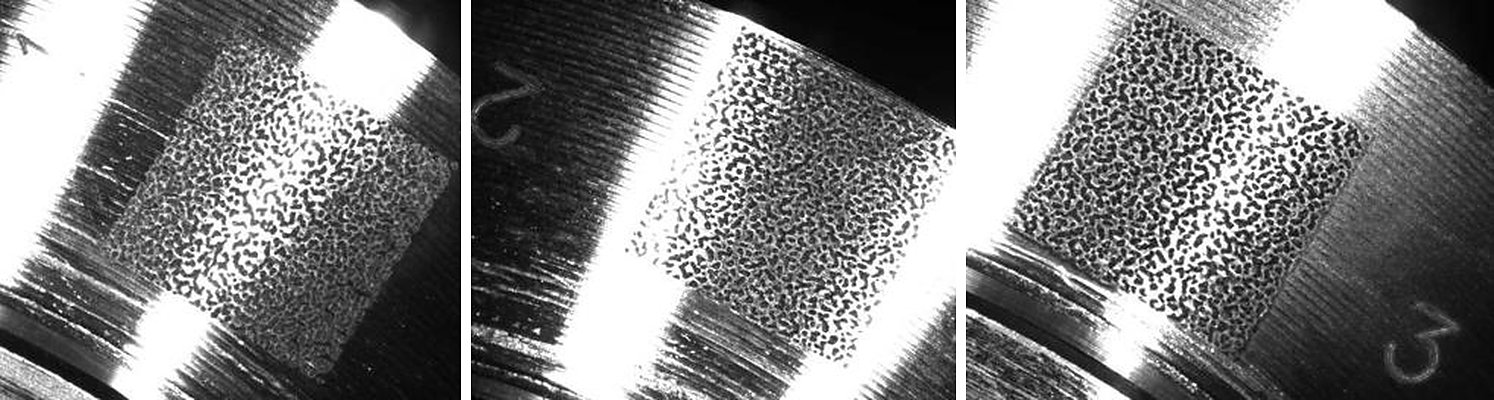
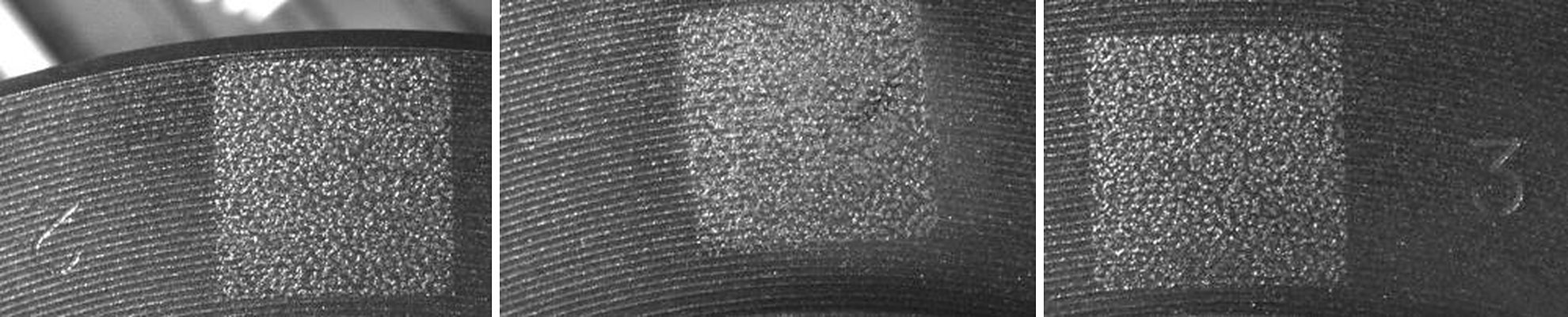
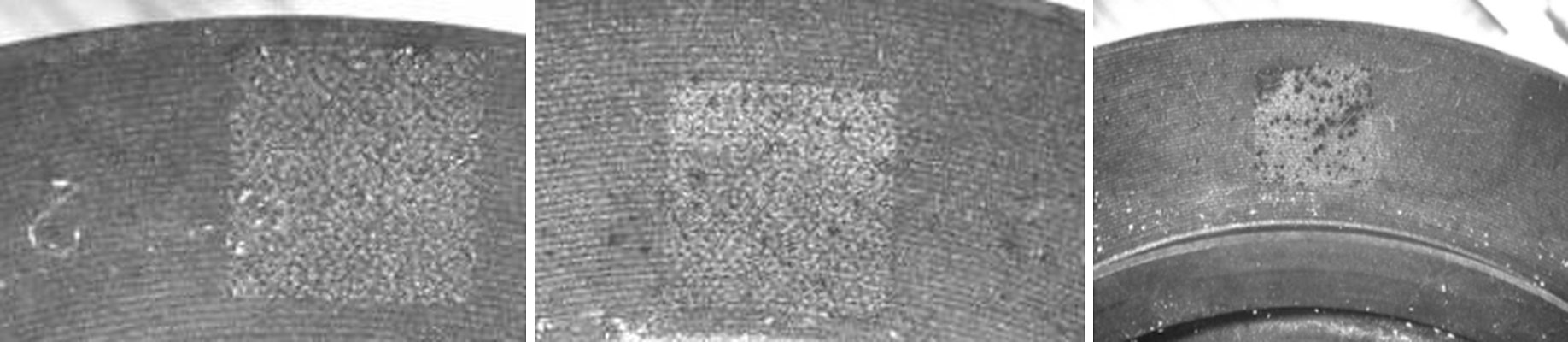
At a powertrain customer’s plant, transmission gears are laser-marked with CDOT Codes immediately after machining and travel through the production finishing chain — heat treatment, sandblasting, phosphating — with the marks read after every step: on the freshly machined part, on the heat-treated surface, on the blasted surface, and through the phosphate coating. The requirement comes from the customer’s own specification: a machine-readable code applied after machining, carrying a 14-character identity — part reference, plant, line, year, day, and the part’s number of the day — that a vision camera can still read at the end of the chain, within a 4-second marking cycle.
| Process step | Surface the mark is read on | Read |
|---|---|---|
| After marking | Freshly machined, bright metal face | Reads |
| After heat treatment | Hardened surface with oxide growth and color shift | Reads |
| After sandblasting | Abraded, matte, uniformly textured surface | Reads |
| After phosphating | Crystalline phosphate coating over the whole part | Reads |
Two details in that table matter as much as the reads themselves. Gear lines run on cycle time, and the mark fits the line’s budget: it is applied on the machined face within the 4-second marking cycle the specification allows. And a read here means a decode — at every step, the mark returns its exact 14-character identity, the part’s full record key.
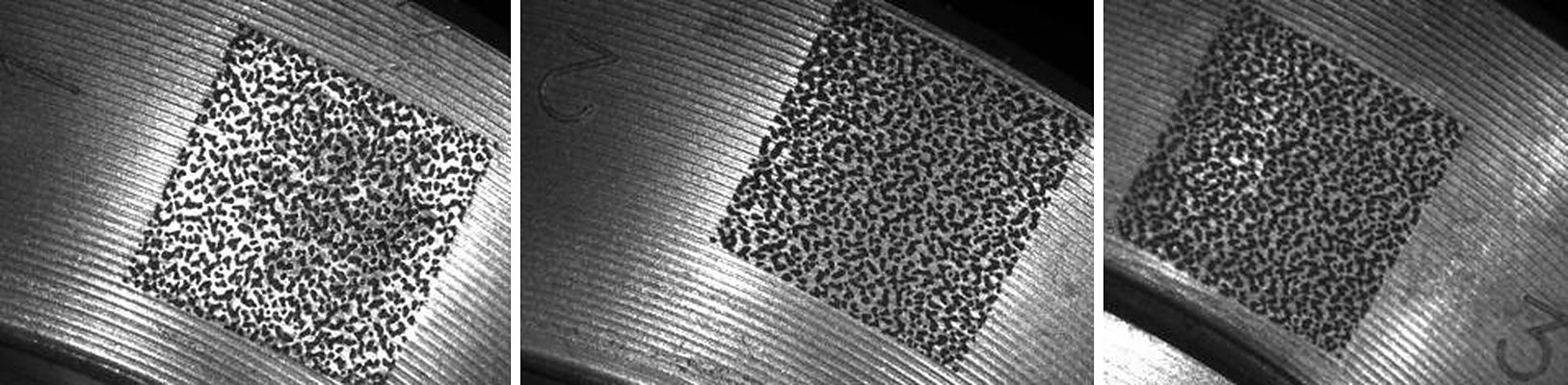
Reading runs on ordinary equipment. A fixed vision camera — a Cognex unit — captures the marked zone and the frames decode in the CDOT decoding application; handheld imagers of the same family and standard phones read the same marks. Acceptance is numeric: a read counts when the decode is valid and the signal strength score clears the recommended threshold of 3.0, two values returned with every scan, so stations can log and trend them like any other process variable.
How the Mark Survives: Reading a Signal, Not Cells
CDOT Code is built for surfaces that keep changing. The identifier is encoded in the frequency domain (U.S. Patent No. 12,242,922) across 62 reference points engraved into the surface as a harmonic dot structure, and decoding — Cosmodot’s Fourier-transform signal analysis — measures the mark’s signal as a whole instead of classifying individual cells as dark or light. Against this chain, that design answers each process in turn. The heat tint shifts the surface’s color, but color is not what is measured: the engraved topography, and therefore the frequency content, stays. Sandblasting erodes the surface, but each frequency component carries the full identifier, so the decoder reconstructs and verifies the complete ID from as few as 3 – 4 intact reference points of the 62 — the property that permits reading at up to 90% physical surface loss. The phosphate layer mutes contrast, but the decoder does not measure contrast in the first place. The deeper comparison with cell-based codes is in our Data Matrix vs QR Code comparison.
The practical consequence sits at the end of the chain: the gear that arrives at gearbox assembly still answers with the identity it was given at machining. A scan can return that identifier to a line-side reader, exchange it with the line’s PLCs — passing data to them or taking data from them — or open the part’s record — line, date, process history — through CTRACE or any traceability platform the plant runs. And because every CDOT Code is unique — drawn from an identifier space larger than 10¹³ — and cannot be copied or reproduced, the mark doubles as an authentication feature on parts that pass between plants and suppliers.
What Changes Between Machining and Assembly
With a mark that reads at every station, the traceability gap between machining and assembly closes. Process data recorded at machining stays attached to the physical part instead of to a batch; a gear taken out of a container after phosphating identifies itself with a scan, with no need to work out which load or line it came from; and each post-process read confirms, part by part, that identity made it through. When a quality issue has to be contained, part-level identity narrows the scope from whole production periods to the parts actually affected.

Frequently Asked Questions
- Can a Data Matrix code survive heat treatment and sandblasting?
- A Data Matrix is decoded from the optical contrast between dark and light cells. Heat treatment degrades that contrast, and sandblasting abrades the marked surface itself, which is why transmission plants commonly lose machining-stage traceability across this chain and re-establish identity downstream instead.
- Why should gears be marked after machining instead of after finishing?
- Because the identity worth carrying is created at machining: which line cut the gear, on which day, as which part of the sequence. A mark applied after finishing can only name the part going forward — everything recorded against the individual part upstream can then be linked only at batch level.
- Can a code be read through a phosphate coating?
- A contrast-based code usually cannot: the crystalline phosphate layer covers the surface, mutes contrast, and fills fine detail. A mark read as a frequency-domain signal engraved in the surface topography can — on the line documented above, marks decode to their exact 14-character identities after phosphating, with an industrial vision camera and with phones.
- How fast can a survivable mark be applied?
- Fast enough for a production line. On the line documented above, the mark is applied on the freshly machined face within a 4-second marking cycle and reads at every later step of the chain. Cosmodot selects the power of the laser marking unit according to the customer’s cycle-time requirement, so the marking station fits the line’s pace rather than constraining it.
- What equipment writes and reads the mark?
- Writing uses a standard fiber laser marking machine, from vector files supplied by the code system — no special marking hardware. Reading uses industrial vision cameras — on the line above, a Cognex camera — handheld imagers, or standard phones; decoding runs in Cosmodot’s signal analysis.
- Does automotive quality management require part-level traceability?
- IATF 16949 requires products to be identified and traceable through production, and customer-specific requirements can extend that to the individual part on powertrain and safety-relevant components. In practice the limit is physical: a part-level requirement can only be met where the part’s mark survives its processes — which is why the finishing chain, not the standard, is usually what decides how far traceability reaches.
Prove CDOT on Your Line
Validate CDOT under your own production conditions: your parts, your heat treatment, your blasting and coating, and your readers.
Start a Technical Validation › Prefer email? Reach us at info@thecosmodot.comReferences
- Laser Focus World — Marking transfer gears (laser marking of transmission gears): laserfocusworld.com
- VCST (automotive gear manufacturer) — Gear traceability: track and trace in automotive manufacturing: vcst.com
- Cosmodot — What Is a Data Matrix Code? (verification parameters, symbol contrast and modulation): thecosmodot.com
- Cosmodot — Data Matrix vs QR Code (error correction limits): thecosmodot.com
- Cosmodot — Marking Steel Pipe Before Heat Treatment: thecosmodot.com
- Cosmodot — What Is a Durable Unique Identifier?: thecosmodot.com
- Cosmodot — CDOT Code: thecosmodot.com/cdot
- Cosmodot — customer case studies: thecosmodot.com/case-studies