Marking Steel Pipe Before Heat Treatment: What Survives the Furnace?

- On a pipe heat treatment line, the tube passes through a furnace at around 1,580 °F (860 °C), a cooling stage, a tempering furnace, and a straightener. The surface that comes out — oxide scale, color shift, flaking — has little in common with the surface that was marked.
- Mills carry identity through this today mainly with three methods: alphanumeric characters stamped into the steel before the furnace, paint or large-character inkjet applied after it, and clip-on metal tags for handling and shipment. Stamping survives the furnace but needs human eyes to read — and even deep-engraved characters can come out of annealing only partially legible; post-furnace marking and tags do not carry identity through the furnace — they re-establish it afterward.
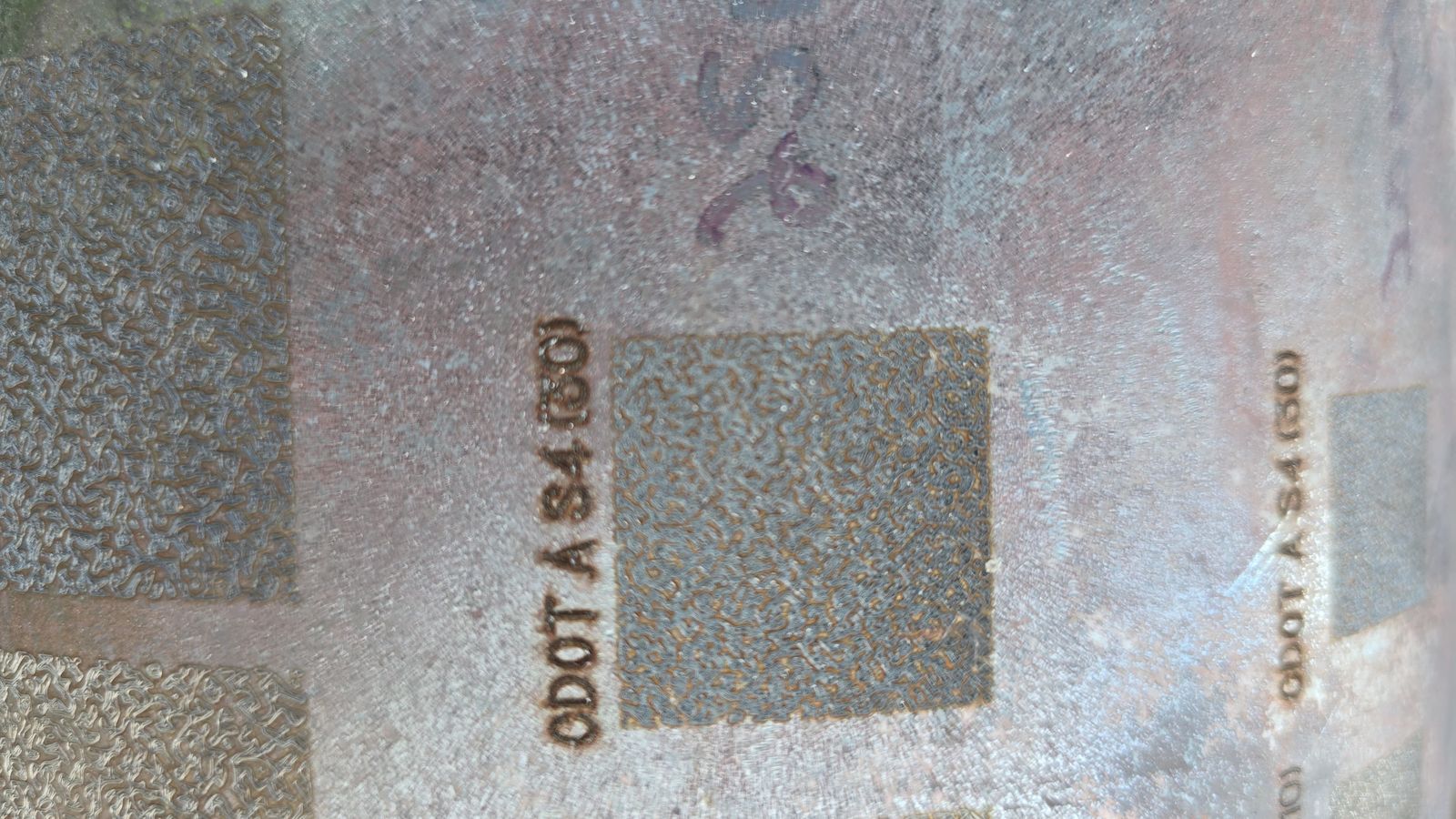
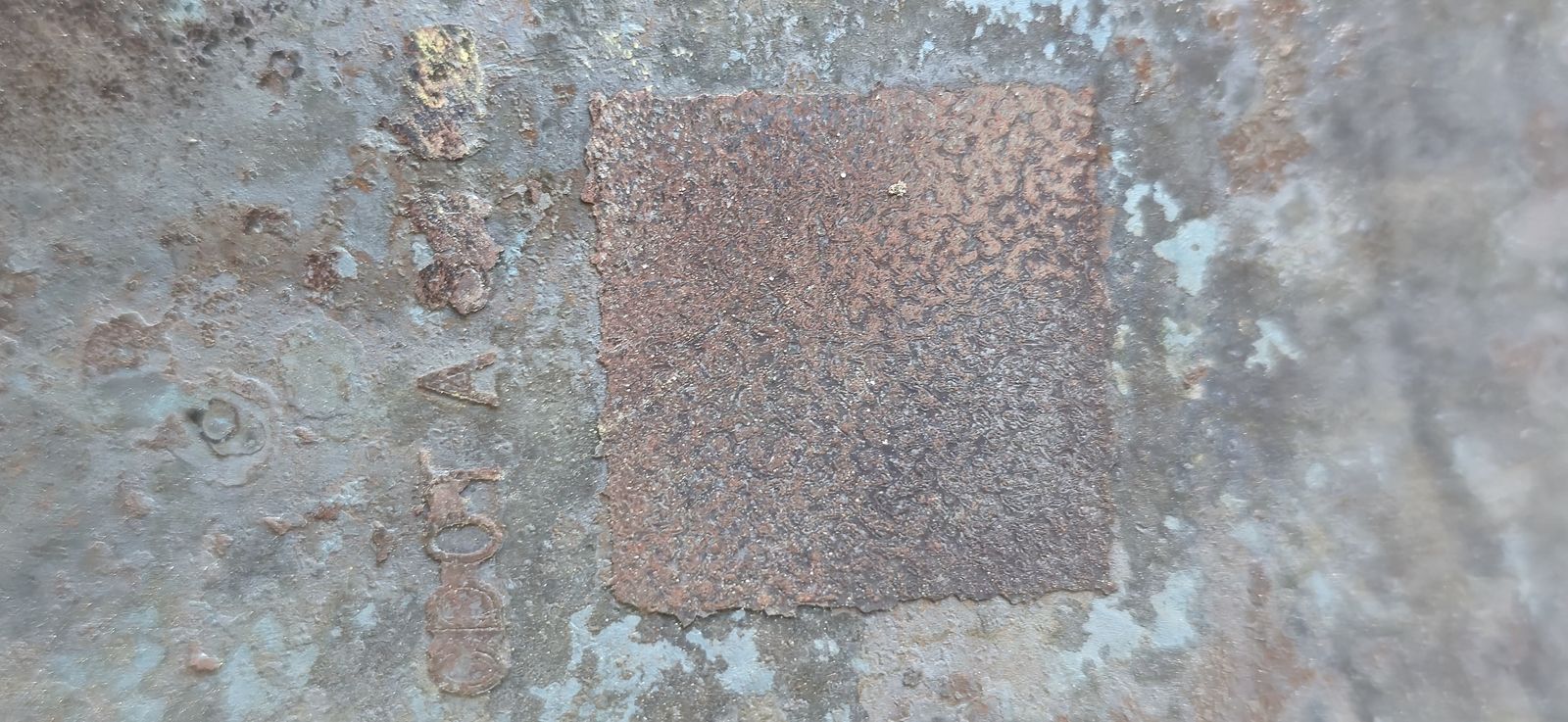
- At a steel pipe mill in Texas, carbon steel pipe carrying laser-applied CDOT Codes went through the mill’s production heat treatment cycles — 1,580 °F (860 °C) annealing with tempering at 950 °F (510 °C) and, in a second stage, at 1,300 °F (705 °C), preceded by a deliberately induced rust film. The CDOT Codes came through every step — furnace, temper, rust, straightener — with 100% scan validity, read on standard phones.
- The mark survives because decoding reads a frequency-domain signal engraved into the surface topography rather than classifying light and dark cells; oxidation changes how the surface looks, not the signal the decoder measures.
Steel pipe is one of the hardest products in manufacturing to keep identified. The processes that give the pipe its mechanical properties — quench-and-temper heat treatment above all — are the same processes that erase whatever was written on its surface. This article walks through what a heat treatment line physically does to a marked surface, where each of the common marking methods stops, and what happened when marks designed for this environment went through a production line at a steel pipe mill in Texas, photographed and scanned at every stage.
What a Heat Treatment Line Does to a Marked Surface
Oil country tubular goods (OCTG) and other high-strength pipe earn their grade in heat treatment. A typical quench-and-temper (Q&T) installation at a pipe mill runs the tube through an austenitizing furnace, a high-pressure water quench, and a tempering furnace — the kind of line U.S. pipe producers have been investing in at scale (U.S. Steel, Fairfield Q&T line). Heating steel to austenitizing temperature and quenching it hardens the structure; tempering at a lower temperature trades some of that hardness back for toughness. A straightener then corrects the distortion the thermal cycle introduced.
Each of those steps transforms the surface. At furnace temperature, the steel oxidizes and grows a scale layer that later cracks and flakes; tempering adds another oxide cycle and shifts the surface color; the straightener’s rolls work the surface under pressure. What comes out is a pipe whose metallurgy is exactly as intended — and whose surface is a new one. On the line documented below, the post-furnace surfaces showed a uniform oxide film, visible color shift, localized pitting, and rust flaking. Any identity that lived in the old surface’s appearance leaves the line with that appearance.
How Steel Is Marked Today — and Where Each Method Stops
On hot product, the identity a mill applies is alphanumeric, stamped into the steel. Stamping is the incumbent for a reason: the characters are geometry, deep enough that scale does not erase them, and they can be applied to product still hundreds of degrees hot — at one European specialty steelmaker, bar ends are stamped by hand on product at up to 900 °C (1,652 °F). The weakness is what the furnace does to the characters. Stamped and engraved characters are read by eye or by OCR cameras, and both depend on the character staying whole: once scale grows over the strokes and flakes away pieces of them, a digit that is merely distorted to a person is unreadable to OCR — and past a point, to the person too.
The natural upgrade is to engrave the same characters deeper with a high-power laser, and mills have run that experiment. In one steelmaker’s own documented evaluation, deep-engraved alphanumeric characters went through an annealing cycle and came out strongly attenuated — in the evaluators’ own assessment, only partially legible without post-processing — and the report concluded that the uncertainty forced them to consider a separate re-reading method. The geometry survived the furnace. Assured readability did not.
The other path concedes the furnace and marks after it. Large-character inkjet and paint systems mark pipe, bar, and billet downstream of heat treatment, onto the scaled surface, and metal identification tags wired or clipped to the product carry barcodes through handling and shipment. Both work — as new identities, applied to product the furnace has already transformed. The connection back to the piece that went in is made by position, batch, and paperwork, and that is the real cost: a post-furnace identity names the finished product, but it cuts piece-level traceability to everything upstream of the furnace. Whatever was recorded against the individual piece before heat treatment — the heat it came from, its process data, its inspection results — can be linked afterward only at batch level.
Missing from that list is a machine-readable 2D code applied before the furnace. Data Matrix and QR are decoded by classifying every cell of the symbol as dark or light, and the parameters that predict their readability — symbol contrast and modulation — measure exactly that difference (the mechanics are in our Data Matrix guide and Data Matrix vs QR Code comparison). Scale defeats a cell-based code twice over: as it grows, dark and light cells weather toward the same shade and the decoder can no longer separate them; as it spalls, it takes pieces of the mark with it — and once the losses exceed what error correction can rebuild, the code is gone.
Why Mark Before the Furnace at All?
If the furnace is where marks die, the obvious workaround is to mark after it — and that is exactly the compromise it sounds like. A pipe’s metallurgical identity is fixed early: the heat of steel it came from, its chemistry, the work order it belongs to. Every stage that handles the pipe before a durable mark exists has to carry that identity some other way — by position, by batch, by paperwork. Each hand-off is a chance to mix material, and a mix-up discovered after heat treatment is expensive in exactly the product where traceability matters most.
A mark applied before the furnace, which is still readable after it, closes that gap: one identity, applied once, that every station on the line — and every scan downstream of it — refers back to. That is the capability the results below demonstrate — on a production line: a real furnace, real scale, and the mill’s own straightener.
Field Results: A Production Line in Texas
At a customer’s steel pipe mill in Texas, carbon steel pipe was laser-marked with CDOT Codes — square marks of 25 and 40 mm, each carrying a unique identifier (the mark format holds up to 520 alphanumeric characters) — and went through the mill’s heat treatment line in two stages.
| Stage | Process conditions | Result |
|---|---|---|
| Stage 1 | Annealing furnace at 1,580 °F (860 °C) + tempering furnace at 950 °F (510 °C), continuous line including straightening | 100% scan validity; no invalid reads |
| Stage 2 | Deliberately induced rust film (controlled oxidation), then 1,580 °F (860 °C) annealing + tempering at 1,300 °F (705 °C) | Full readability retained — including after the surface was brushed |
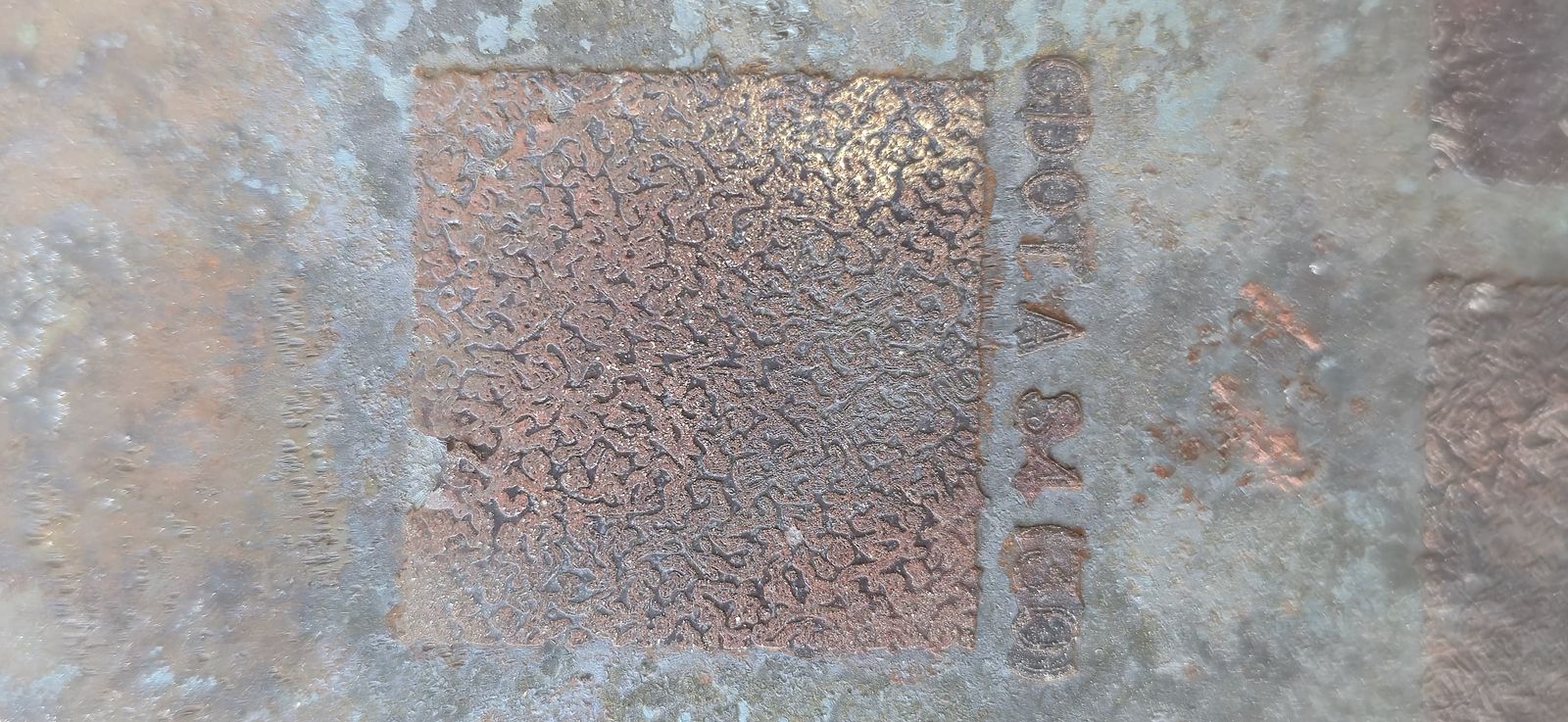
The second stage is worth dwelling on. Before the pipes re-entered the furnace, the marked surfaces were deliberately rusted, so that the marks faced oxidation twice over: a corrosion film going in, and furnace scale forming on top of it. The elevated tempering at 1,300 °F (705 °C) added a harsher thermal cycle than the first pass.
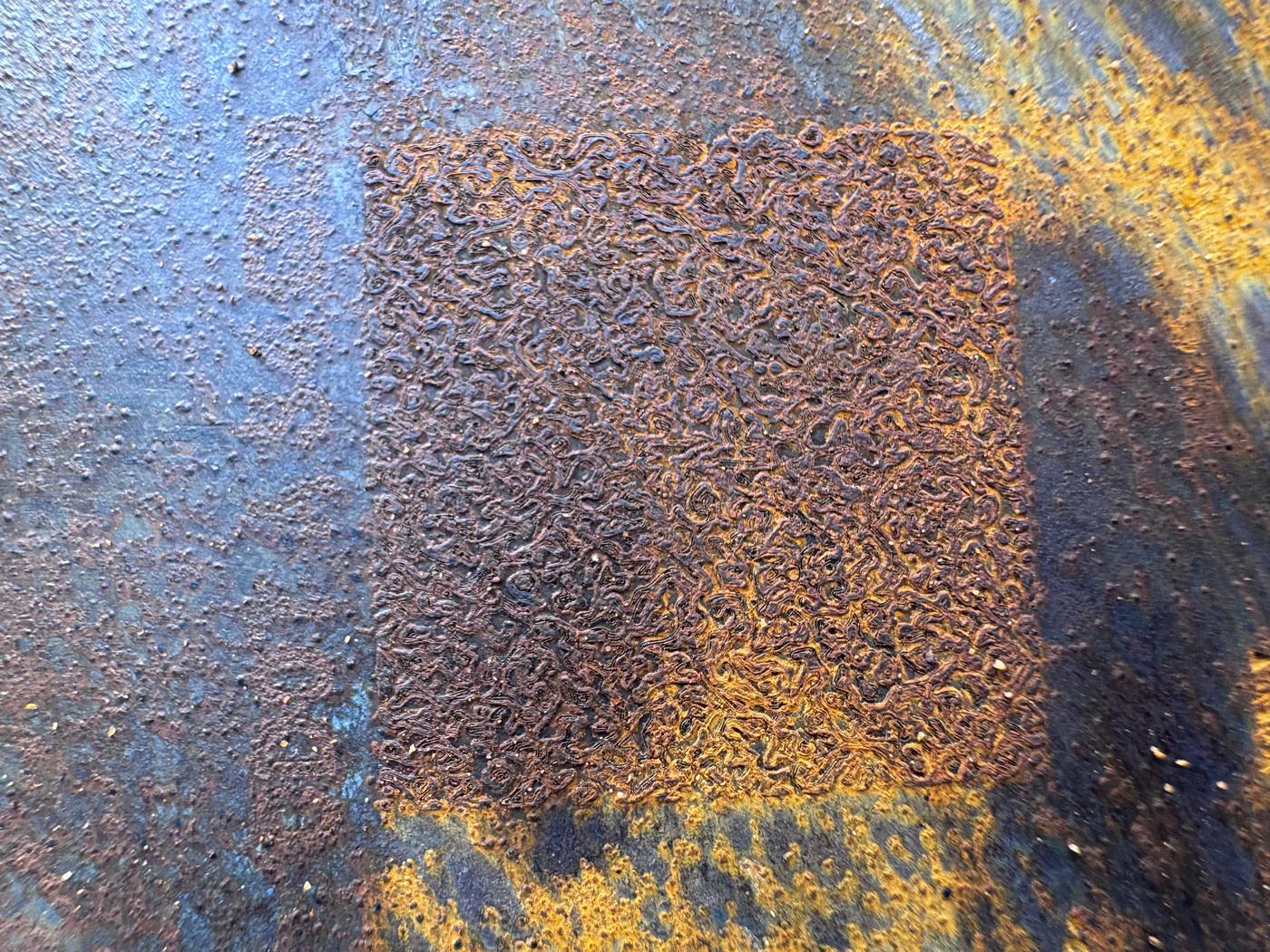
The marks were scanned after each stage, on the oxidized surfaces as they came off the line, with standard phones — iPhones and Samsung phones. The CDOT Codes came through every step with 100% scan validity; signal strength scores ranged from 3.0 to 5.1, averaging 4.62 ± 0.75 after the first stage. Alongside each reading, the logged surface condition was what you would expect to defeat a code — “uniform oxide coverage,” “dense oxide layer, light pitting,” “reddish film with localized roughness,” “rust flaking” — and the mark read on every one of them.
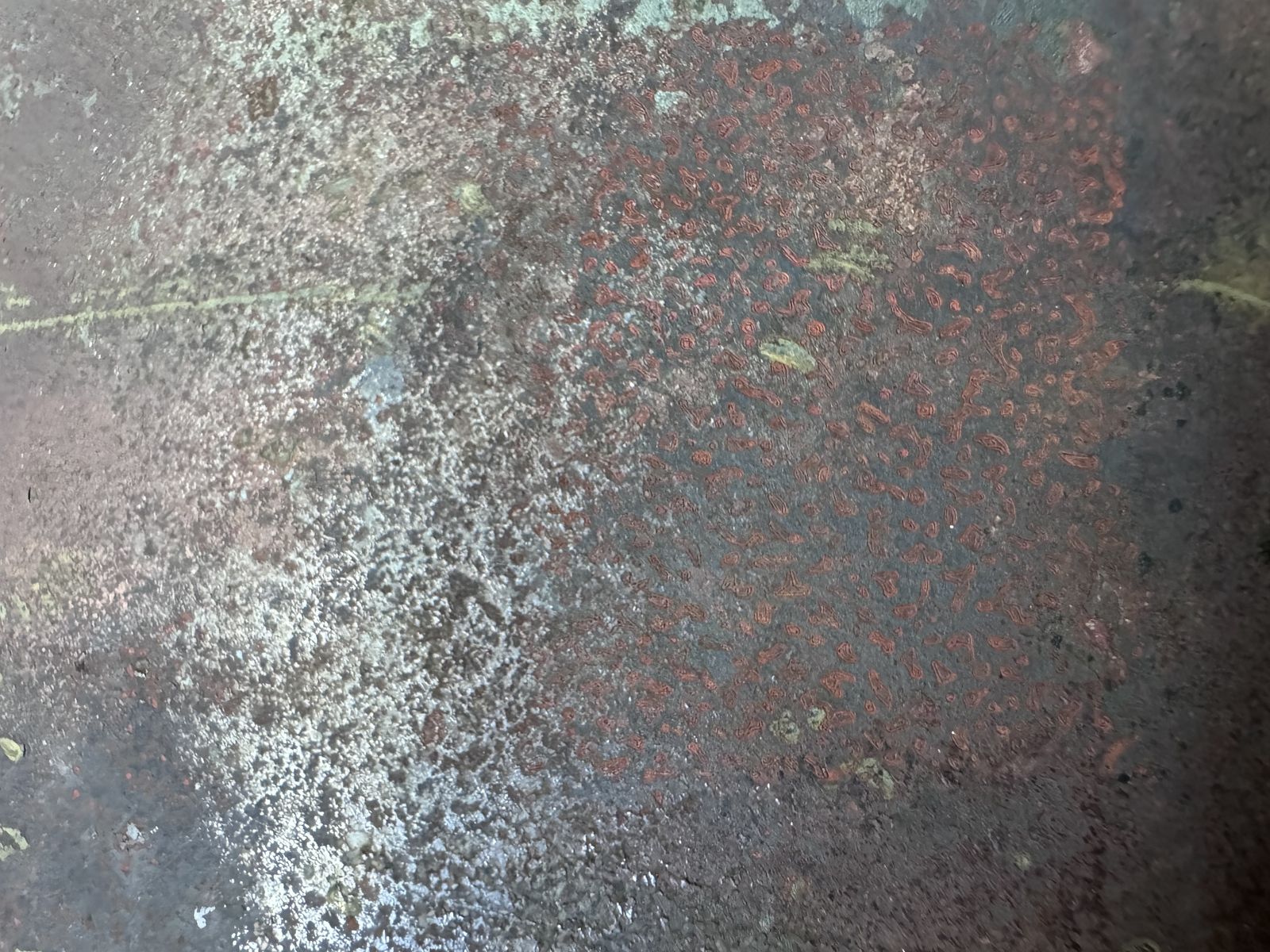
One more observation from the photographs matters for anyone comparing methods: next to each CDOT mark, plain text was lasered onto the pipe as a human-readable label. After the furnace cycles, several of those text labels are difficult to make out against the scale — while the mark beside them still returned valid decodes. Same laser, same surface, same furnace; the difference is what the two depend on to be read.
How the Mark Survives: Reading a Signal, Not Cells
CDOT Code is built for exactly this failure mode. The identifier is encoded in the frequency domain (U.S. Patent No. 12,242,922) across 62 reference points engraved into the surface as a harmonic dot structure, and decoding — Cosmodot’s Fourier-transform signal analysis, running on an industrial PC, a virtual machine, or in the cloud — measures the mark’s signal as a whole instead of classifying individual cells as dark or light. That design has two consequences, both visible in the photographs above. First, contrast independence: an oxide film that shifts the whole surface’s color leaves the engraved topography, and therefore the frequency content, in place. Second, redundancy at the signal level: each frequency component carries the full identifier, so the decoder reconstructs and verifies the complete ID from as few as 3 – 4 intact reference points of the 62 — the property that permits reading at up to 90% physical surface loss. A capture device as ordinary as a phone camera feeds that analysis, which is why the post-furnace scans above needed no special imaging hardware.
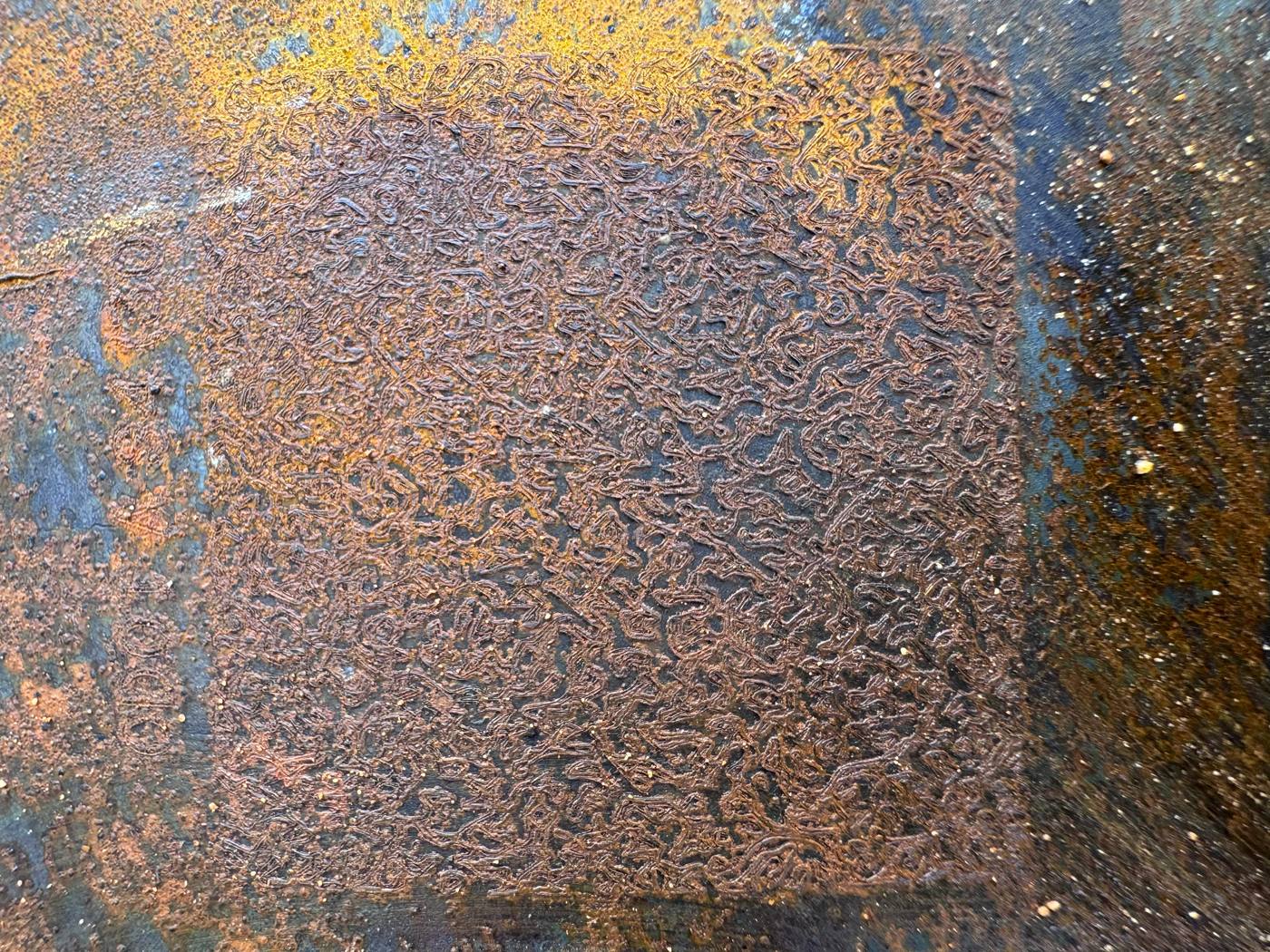
The same decoding path is what connects the mark to the mill’s systems: a scan can return the identifier to a line-side reader, or open the pipe’s record — heat, production history, quality data — through the CTRACE platform. And because every CDOT Code is unique — drawn from an identifier space larger than 10¹³ — and cannot be copied or reproduced, the mark that survives the furnace also serves as an authentication feature in addition to an address. The broader selection logic for identifiers that must outlive their processes is in our durable unique identifier guide.
What Pre-Furnace Identity Changes
With a mark that enters the furnace and comes out readable, the identity chain inverts. Instead of re-establishing who a pipe is after every transforming process, the mill establishes it once — at the first station where the pipe exists as an individual — and every subsequent station, including the ones on the far side of the furnace, reads rather than re-writes. Mixing risk concentrated at hand-offs disappears with the hand-offs themselves; the scan that used to be impossible right after the furnace becomes a routine check.
Frequently Asked Questions
- Why do stamped alphanumeric characters become hard to read after heat treatment?
- The characters are geometry, so they survive the furnace — but scale grows over the strokes and flakes pieces of them away. A distorted digit that a person can still puzzle out is already unreadable to an OCR camera, and with enough scale it becomes unreadable to the eye as well. That is why deep-engraved characters can come out of annealing only partially legible.
- Can a barcode survive heat treatment?
- Cell-based barcodes — Data Matrix, QR — generally do not, because decoding them depends on the optical contrast between dark and light cells, and furnace scale collapses that contrast. On the production line documented above, frequency-domain CDOT marks survived 1,580 °F annealing and tempering cycles up to 1,300 °F with 100% scan validity, because their decoding does not depend on cell contrast.
- What temperatures did the marks survive?
- Annealing at 1,580 °F (860 °C) in both stages, with tempering at 950 °F (510 °C) in the first stage and 1,300 °F (705 °C) in the second — the second stage additionally preceded by a deliberately induced rust film. Readability held in full: 100% scan validity.
- Why mark pipe before heat treatment instead of after?
- A pipe’s identity — heat, chemistry, work order — is fixed before the furnace, so marking after it means carrying that identity through the hottest, most error-prone part of the line by position and paperwork. A mark that survives the furnace lets one identifier, applied once, serve the whole line.
- Does mill scale make codes unreadable?
- For contrast-based codes, typically yes: scale pulls dark and light cells toward the same color, which defeats decoding even when the mark’s geometry is intact. A mark read as a frequency-domain signal engraved in the surface topography is not defeated by the color shift; the scans above were made on scaled, oxidized surfaces.
- Can the mark be read through rust?
- Yes. The marks were deliberately rusted before re-entering the furnace, and remained fully readable afterward — including after the surface was brushed. Signal strengths on rusted and scaled surfaces ranged from 3.0 to 5.1, all valid.
- Is special equipment needed to write and read the mark?
- No. Writing uses a standard laser marking machine — no special marking hardware. Reading is done with phones, tablets, or industrial cameras; the post-furnace scans above were made with iPhones and Samsung phones.
Prove CDOT on Your Line
Validate CDOT under your own production conditions: your furnace, your pipe, your processes, and your readers.
Start a Technical Validation › Prefer email? Reach us at info@thecosmodot.comReferences
- U.S. Steel — Quench & Tempering line investment, Fairfield Tubular Operations: bicmagazine.com
- Cosmodot — What Is a Data Matrix Code? (verification parameters, symbol contrast and modulation): thecosmodot.com
- Cosmodot — Data Matrix vs QR Code (error correction limits): thecosmodot.com
- Cosmodot — What Is a Durable Unique Identifier?: thecosmodot.com
- Cosmodot — CDOT Code: thecosmodot.com/cdot
- Cosmodot — customer case studies: thecosmodot.com/case-studies