What Is a Durable Unique Identifier? A Manufacturing Guide
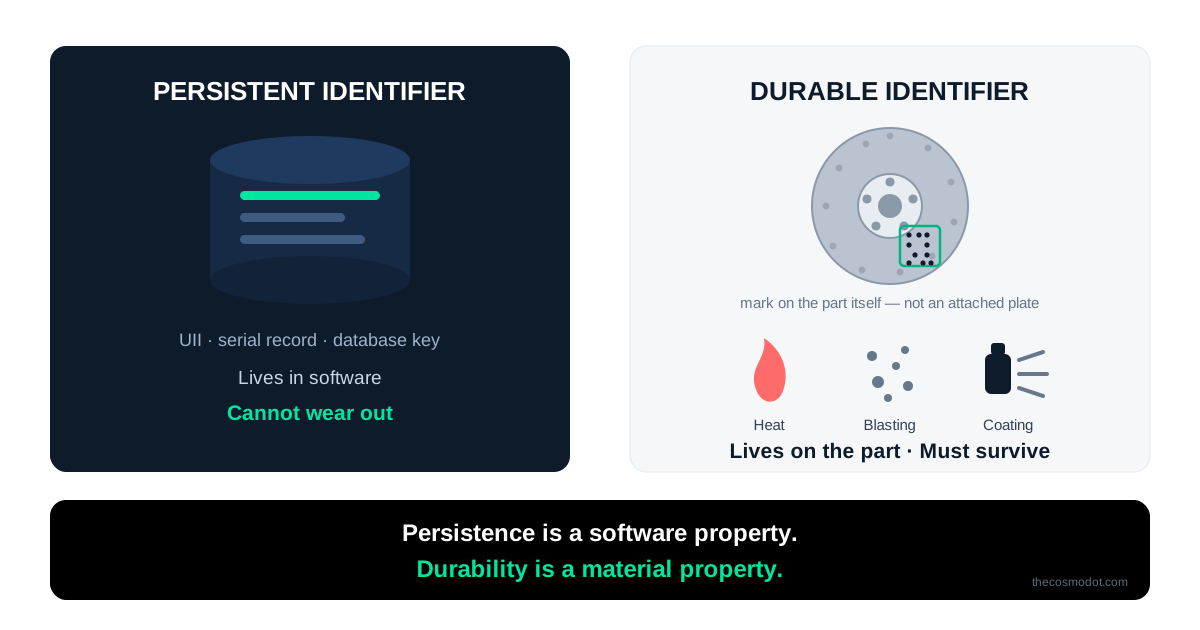
- A serial number in the database is only as good as the mark on the part: persistence is a software property, durability is a material property.
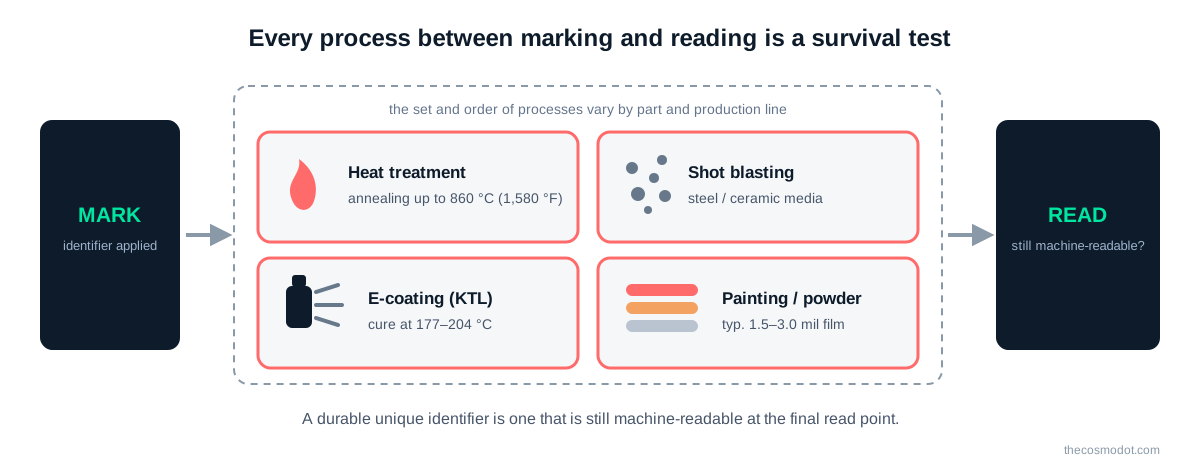
- Every step between marking and reading — furnace, blast cabinet, coating line — is a survival test for the mark.
- Mark as early as the process chain allows; marking late is easier but leaves upstream steps untraceable.
- Pick the marking method from your specific process chain, and verify readability after the last step that changes the surface.
A unique identifier is a value assigned to one item so that no other item carries the same one. Serial numbers, VINs, and database keys all work this way.
In IT systems, identifiers are stored and compared in software. When they need to stay valid for decades, the field uses the term persistent identifier; a DOI on a scientific paper or an ORCID for a researcher are common examples. Persistence here is a data-management task: the identifier must not change, and it must keep resolving to the correct record.
A manufactured part has a different requirement. Its identifier has to be written on the part itself, as a serial number, a nameplate, or a 2D code, because that is the only way to connect the physical item to its manufacturing record when it surfaces later in a quality investigation, a warranty claim, or a recall. Between marking and that final read, the part may pass through a hardening furnace, a shot blasting cabinet, and several coating lines, and each of these can remove or bury the mark.
A durable unique identifier is a unique identifier applied to a part in a form that stays machine-readable through all of the processes and service conditions the part is exposed to, from marking to end of life. Persistence is a software property; durability is a material property. A traceability program needs both: a persistent record in the database, and a durable mark on the part that keeps pointing to it.
Serialized marks are what make unit-level traceability work in practice. They limit a recall to the affected serial numbers instead of entire production periods, link each part to the material lot and process data that produced it, support warranty and liability documentation, and give inspectors a way to check that a part is genuine. At one European defense prime contractor, for example, serialized marks on armored chassis and engine components are what let a field event be traced back to the originating process or supplier — provided the mark is still readable after the shot blasting and painting those components go through. The rest of this article covers the durability side of the requirement: which processes destroy markings, what the standards require, and how the available marking methods compare.
UID, IUID, and UII in Defense Contracting
Within the U.S. Department of Defense, unique identification is implemented through the Item Unique Identification (IUID) program:
- IUID is the DoD program and registry. When DFARS clause 252.211-7003 is included in a contract, delivered items with a unit acquisition cost of $5,000 or more must carry item unique identification; the clause also covers items below that threshold when the requiring activity designates them — for example, DoD serially managed, mission-essential, or controlled inventory items (DFARS 252.211-7003; DFARS 211.274-2). Marking is performed in accordance with MIL-STD-130, and serially managed items are governed by DoDI 8320.04 (DoDI 8320.04). The program also applies unique identification to critical materiel identified as susceptible to counterfeiting (OUSD(A&S)).
- UID is the physical marking on the item — a Data Matrix symbol in ECC 200 format with accompanying human-readable information, produced and verified to MIL-STD-130 requirements (DoDI 8320.04).
- UII (Unique Item Identifier) is the globally unique data value encoded in the mark and recorded in the IUID Registry. The DFARS clause defines two serialization constructs for building it: Construct 1 (enterprise identifier + serial number) and Construct 2 (enterprise identifier + original part number + serial number) (DFARS 252.211-7003); the current DoDI additionally defines a simplified IUID 2.0 construction for DoD serially managed items (DoDI 8320.04).
Here the UII is the persistent identifier: it lives in the registry and cannot degrade. The UID mark is the durable identifier: it lives on the item and must survive. DoD policy requires the production quality of the Data Matrix mark to be verified against MIL-STD-130 with a 2D verification tool (DoDI 8320.04), which makes mark durability a compliance requirement rather than an operational preference.
Identifier, Carrier, and Survival
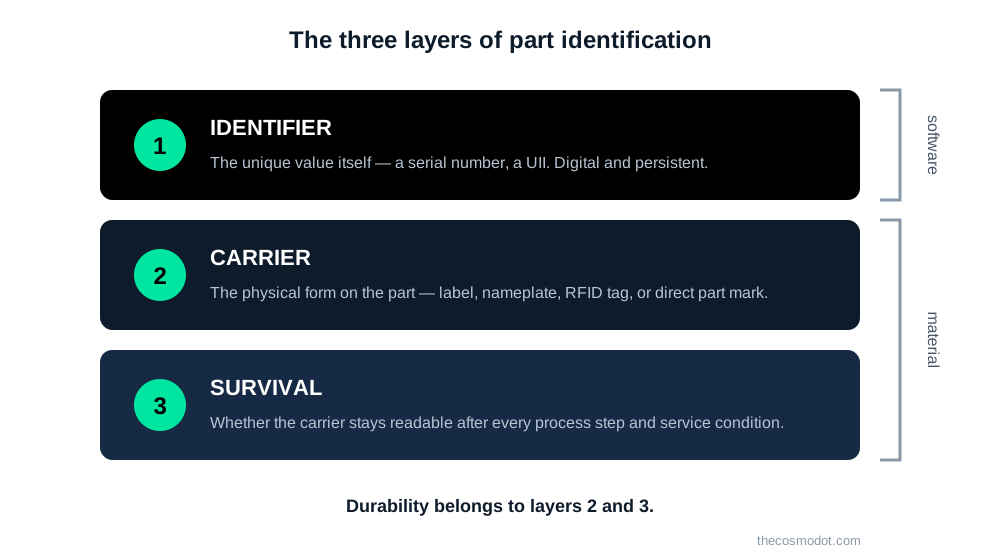
The persistent half and the durable half of a traceability system can be separated into three layers:
- The identifier — the unique value itself (a serial number, a UII). Digital and persistent; this is the half that lives in software.
- The carrier — the physical form the identifier takes on the part: a printed label, a metal nameplate, an RFID tag, or a mark applied directly to the part surface (direct part marking, DPM) by methods such as dot peen, laser marking, or electrochemical etching.
- Survival — whether the carrier remains readable after each process step and service condition between marking and the final read.
Durability belongs to layers 2 and 3. Evaluating a durable unique identifier therefore means evaluating a carrier against a specific sequence of processes.
Manufacturing Processes That Affect Mark Readability
| Process | Typical conditions | Effect on identification marks |
|---|---|---|
| Heat treatment | Furnace temperatures up to 860 °C (1,580 °F), e.g., pipe annealing, with tempering at 677 – 704 °C (1,250 – 1,300 °F) | Standard label stocks fail above roughly 150 °C (302 °F) and polyimide constructions above roughly 300 °C (572 °F); higher-rated ceramic and metal tags require mechanical attachment (high-temperature label data). Codes printed or laser-applied on the part itself degrade as the surface oxidizes until readers can no longer decode them (U.S. Patent 12,242,922); marking after heat treatment leaves earlier process steps untracked |
| E-coating / cataphoresis (KTL) | Cured film of typically 18 – 28 µm (0.7 – 1.1 mil) (Products Finishing); cure at part temperatures of 177 – 204 °C (350 – 400 °F) for 10 – 20 minutes in typical cathodic epoxy systems (PCI Magazine) | Coating film fills engraved cells and reduces contrast. Published laser-marking test data indicates Data Matrix cell sizes of at least 0.75 mm (0.030 in) are required for readability after e-coating (published laser marking test data) |
| Painting / powder coating | Powder coating film builds of typically 1.5 – 3.0 mil (about 40 – 75 µm), with harsher service conditions requiring 2.5 – 3.5 mil (65 – 90 µm) (Products Finishing) | Covers shallow marks. NASA research on reading Data Matrix symbols through paint required magnetic inks and a dedicated magnetic scanner (NASA Spinoff) |
| Shot blasting / sandblasting | Steel or ceramic media impact | Identifiers marked on castings are typically erased by shot blasting; in published laser tests, 0.4 mm cells were unreadable after blasting while deep-marked 0.6 – 0.8 mm cells survived (published laser marking test data) |
| Phosphating, galvanizing, anodizing | Chemical conversion or plating | Surface chemistry and texture change reduce mark contrast, and hot-dip galvanizing buries the mark beneath a zinc layer (Cosmodot case studies) |
| Casting, forging, hot stamping | Molten metal poured into molds; hot blanks deformed in forging and stamping | No carrier can be attached to molten or deforming metal; unless the identity is transferred from the tooling — a mark on the mold or core that prints onto the cast surface — identification starts only after forming |
Survival requirements do not end at the factory gate. MIL-STD-130 expects the mark to remain readable for the item's service life, which adds field conditions — wear, corrosion, cleaning chemicals, outdoor exposure — to the list, and means the reading environment years later may be a handheld scanner in a depot rather than a fixed camera on a line.
A mark that is fully durable in one production line may fail in another, so the practical question is whether a given carrier survives the specific sequence of processes between marking and reading in that line.
Carrier Options for Durable Unique Identification
| Carrier | Applied at | Heat treatment | Shot blasting | E-coating / paint | Reading |
|---|---|---|---|---|---|
| Polyester / foil label | After finishing | Not designed for furnace exposure | Not designed for abrasive exposure | Applied after coating only | Standard scanner |
| Metal nameplate | Attached by rivet, screw, or adhesive | Depends on attachment method and material rating | Not intended for in-process abrasive steps | Not intended to pass through coating lines; attached after finishing | Standard scanner |
| RFID tag | Attached | Standard passive UHF tags operate at up to about +85 °C (185 °F); specialty high-temperature tags survive short exposures to roughly 250 °C (482 °F), but the chip typically cannot be read until it cools below ≈125 °C — all far below heat-treatment furnace temperatures (rfidtag.com; Xerafy) | Not intended for abrasive exposure | Survivable in some configurations (e.g., paint-shop-rated tags) | RFID reader |
| Dot peen Data Matrix (DPM) | Direct on part | The indentation survives furnace temperatures; readability afterwards depends on oxide scale and how the scale is removed | The impacting media deforms the surface and closes the indentations | Cells fill with coating | Standard DPM reader |
| Laser-marked Data Matrix (DPM) | Direct on part | Documented for aluminum temper treatments (T4/T6/T7) on castings; steel-scale furnace conditions are not covered by the published data (published laser marking test data) | Requires dedicated deep marking: in published tests, 0.4 mm cells were unreadable after blasting while 0.6 – 0.8 mm cells survived, at up to 12 passes and ≈ 37 seconds per code (published laser marking test data) | Requires cell sizes ≥ 0.75 mm (0.030 in), which enlarges the symbol and the marked area for the same data (published laser marking test data) | Standard DPM reader |
| CDOT Code (DPM symbology) | Direct on part, existing laser / dot peen equipment | Readable after full furnace cycles up to 860 °C (1,580 °F) (Cosmodot) | Readable after shot blasting on brake discs, armored vehicle components, and drawn steel pipes (Cosmodot customer case studies) | Readable after KTL (cataphoretic) coating on BEV battery housings, subframes, and axles, and after multi-layer powder and liquid paint on wheels (Cosmodot customer case studies) | Standard DPM reader |
In customer applications, CDOT marks have been verified readable — the identifier decoded from the surviving mark geometry — after phosphating (brake discs), under zinc coating with salt-spray testing (brake calipers), after supplier-applied nickel plating (copper conductors), and beneath hot-dip galvanization (steel profiles) (Cosmodot customer case studies).
CDOT Code is a frequency-domain marking symbology developed for these process conditions (U.S. Patent No. 12,242,922). Published performance figures include read accuracy above 99% and identifier capacity of up to 520 alphanumeric characters within 3 mm² (0.005 in²), with readability validated through heat treatment, shot blasting, KTL coating, multi-layer painting, phosphating, zinc and nickel plating, and hot-dip galvanization (Cosmodot customer case studies). For comparison, a conventional Data Matrix needs a 72 × 72-module symbol to hold 520 alphanumeric characters (ISO/IEC 16022 symbol attributes; symbologies are compared in our guide to 2D barcode types): at a 0.5 mm cell that is a 36 × 36 mm code, and at the 0.75 mm cells required after e-coating, 54 × 54 mm — against 3 mm² for CDOT.
Damage limits. Readability is maintained with up to 90% physical surface loss; beyond that, or when the entire marked area is machined away, the identity is lost like any surface mark.
Selecting a Durable Identification Method
- Map the process chain. List every step between the marking point and each reading point. Each step is a survival requirement.
- Set the marking point as early as the chain allows. Marking late in the chain sidesteps durability requirements, but it leaves upstream steps untraceable — or traceable only at batch level, which weakens every link built on the identifier.
- Choose the carrier from the read points, not from a catalog. Locate every point in the chain where the identifier must be read. A read point downstream of heat treatment, blasting, or coating rules out labels, tags, and printed codes, and narrows the choice to direct part marking whose readability is documented for those specific steps (see the carrier table above).
- Optimize the marking parameters as one system. Readability is governed by the part (alloy, surface condition), the mark (code size, marking depth), the marking process (hardware configuration, dwell time, cycle time), and the downstream chain (process atmosphere, number of cycles). These are tuned together for the chain the part will actually travel — not for any single step in it.
- Verify readability at the point of use. Assess mark quality after the last step that changes the surface, with the reading equipment installed on the line, and grade it against whichever specification the contract calls out: ISO/IEC 29158:2025 for direct part marks, ISO/IEC 15415 for printed 2D symbols, MIL-STD-130 for DoD items — plus any customer-specific marking requirements on the drawing.
Frequently Asked Questions
- What is a unique identifier?
- A value assigned to exactly one item so it can be distinguished from every other item — a serial number on a part, a VIN on a vehicle, a primary key in a database. Uniqueness is guaranteed by the issuing system: no two items ever receive the same value.
- What is a durable unique identifier?
- A unique identifier applied to a physical part in a form that remains machine-readable through every manufacturing process and service condition between marking and the last time the part must be identified. Durability describes the mark itself — its geometry and contrast on the part — not the data record behind it.
- What is the difference between a persistent identifier and a durable identifier?
- Both answer the same question — will the identifier still work years from now? — but in different worlds. A persistent identifier stays resolvable inside software: the value never changes and always points to the correct record. A durable identifier stays physically readable on the part through furnaces, abrasion, and coating lines. A complete traceability system needs both: the persistent record in the database, and the durable mark that connects the physical part to it.
- What is the difference between UID, IUID, and UII?
- IUID is the U.S. Department of Defense program and registry for uniquely identifying items. UID is the physical identification mark applied to the item under MIL-STD-130 — typically a Data Matrix symbol with human-readable text. UII is the globally unique data value encoded inside that mark and recorded in the IUID Registry, built from the enterprise identifier plus the serial number (and, in one construct, the original part number).
- What is direct part marking (DPM)?
- Applying the identifier onto the part's own surface — by dot peen indentation, laser marking, or electrochemical etching — instead of attaching a label, nameplate, or tag. DPM is used where attached carriers cannot survive the process chain or the part's service life, and it is the marking approach MIL-STD-130 expects for items that outlive any label.
- How do I mark parts that go through heat treatment?
- There are three approaches. Marking after the furnace is simplest, but it leaves every earlier process step untracked. Marking before the furnace with an indentation-based method preserves the geometry, but oxide scale usually destroys the contrast a standard reader needs. The third approach is a mark designed to be decoded after the furnace: CDOT codes, for example, are read after full furnace cycles up to 860 °C (1,580 °F), because decoding works on the surviving mark geometry rather than on cell-by-cell contrast.
- Can a 2D code be read after painting or e-coating?
- Only if the mark geometry outlives the coating film. A film of tens of microns fills fine engraved cells and flattens contrast — published laser tests require Data Matrix cells larger than 0.75 mm after e-coating, and NASA needed magnetic inks to read codes through paint. CDOT keeps the code at 3 mm² and readable under KTL and multi-layer paint, because the decoder reconstructs the identifier from the mark's surviving signal rather than from individual cells.
Prove CDOT on Your Parts
Validate CDOT under your own production conditions — your marking hardware, your parts, your processes, and your industrial readers.
Start a Technical Validation › Prefer email? Reach us at info@thecosmodot.comReferences
- DFARS 252.211-7003, Item Unique Identification and Valuation — Acquisition.gov: acquisition.gov/dfars/252.211-7003
- DFARS 211.274-2, Policy for Item Unique Identification — Acquisition.gov: acquisition.gov/dfars/211.274-2
- DoD Instruction 8320.04 — DoD Serially Managed Items of Tangible Personal Property: esd.whs.mil
- OUSD(A&S) — Item Unique Identification (IUID): acq.osd.mil
- ISO/IEC 29158:2025 — Bar code symbol quality test specification — Direct part mark (DPM): iso.org
- ISO/IEC 15415 — Bar code symbol print quality test specification — Two-dimensional symbols: iso.org
- U.S. Patent 12,242,922 — Method for traceability of raw materials, components, objects, and products exposed to harsh operational conditions in industry: patents.google.com
- Products Finishing — E-Coat Film Thickness Capabilities: pfonline.com
- Products Finishing — Coating Thickness Guidelines: pfonline.com
- PCI Magazine — Electrocoat Finishes: How Low Can You Go?: pcimag.com
- Laser marking test data — DPM and post-process treatments: laserax.com
- High-temperature RFID tag considerations: rfidtag.com
- Xerafy — High-Temp RFID Tags (MICRO Series): xerafy.com
- High-temperature label constructions and limits: blog.barcodefactory.com
- NASA Spinoff — Reading Through Paint: spinoff.nasa.gov
- Cosmodot — CDOT Code: thecosmodot.com/cdot
- Cosmodot — Customer Case Studies: thecosmodot.com/case-studies