Data Matrix vs QR Code: A Technical Comparison
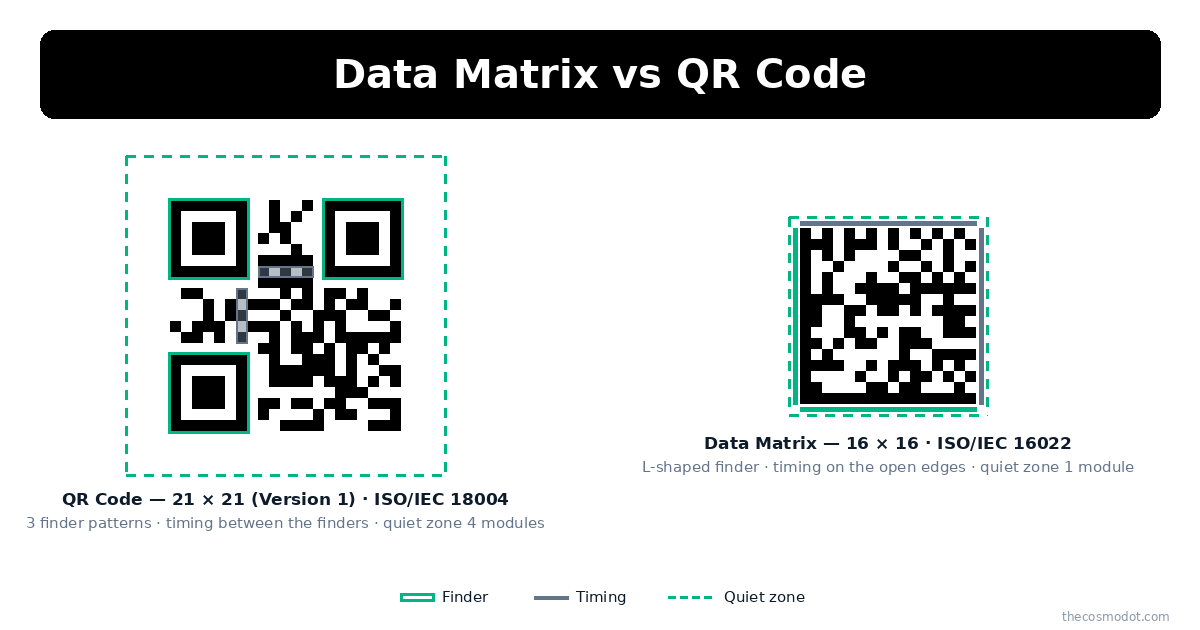
- QR Code (ISO/IEC 18004) and Data Matrix (ISO/IEC 16022) are both square matrix symbologies with Reed – Solomon error correction. Industrial imagers decode both; phone camera apps read QR natively, while Data Matrix requires a scanning app.
- For a typical 20 – 50-character identifier, the Data Matrix symbol occupies roughly half the area of the equivalent QR, including quiet zones: one module against four.
- QR error correction is selectable between approximately 7% and 30%; Data Matrix error correction is fixed by symbol format at roughly a quarter to a third of the codewords.
- GS1 selected QR with GS1 Digital Link for retail point of sale (Sunrise 2027) and GS1 Data Matrix for healthcare UDI; MIL-STD-130 and the part-marking standards specify Data Matrix.
Data Matrix and QR Code are the two most widely used 2D symbologies. Both store data in a grid of square modules, both use Reed – Solomon error correction, and both are open ISO standards. On industrial equipment the two are interchangeable to read: camera-based imagers decode both. For consumers they are not: phone camera apps read QR codes natively, while a Data Matrix requires a dedicated scanning app. This article compares the two symbologies on structure, capacity, physical size, error correction, scanning, and the application standards that specify each, and closes with the question of whether the two can be combined.
A Short History
QR Code was developed in 1994 at Denso Wave, a Toyota-group company, for tracking automotive components through assembly; the design goal was fast reading in any orientation (Denso Wave). Denso published the specification and did not enforce its patent, and with the spread of camera phones QR became the standard consumer-facing code. Data Matrix was developed in the late 1980s by International Data Matrix, Inc. for identifying small items; NASA’s part-marking programs adopted it for aerospace parts, and it became the standard symbology of direct part marking. Its development and standards history are covered in our Data Matrix guide.
Symbol Structure
| QR Code | Data Matrix | |
|---|---|---|
| Finder pattern | Three square finder patterns in the corners; alignment patterns inside larger symbols | One L-shaped solid border on two sides |
| Size information | Timing pattern plus a 15-bit format information field | Timing (clock) pattern on the two open sides |
| Quiet zone | 4 modules on all sides | 1 module on all sides |
| Masking | Data region is XOR-masked with one of eight patterns | Not used |
| Formats | 40 square versions, 21 × 21 to 177 × 177; Micro QR; rectangular rMQR | 24 square formats, 10 × 10 to 144 × 144, plus 6 rectangular; extended by DMRE |
| Error correction | Selectable: L ≈7%, M ≈15%, Q ≈25%, H ≈30% recovery | Fixed by format, roughly 25 – 33% of codewords |
| Standard | ISO/IEC 18004 | ISO/IEC 16022 |
QR’s finders are built from the same dark and light modules as data, so the encoder applies one of eight XOR mask patterns to balance the symbol and avoid data patterns that interfere with locating it, and records the choice in a format-information field the decoder reads first (ISO/IEC 18004 reference documentation). Data Matrix’s solid border does not occur in data, so it uses neither masking nor a format field. QR therefore reserves modules for three finders, alignment patterns, timing, and format information; Data Matrix reserves only its border and timing edges.
Capacity and Symbol Size
Maximum capacities favor QR: 7,089 numeric or 4,296 alphanumeric characters at Version 40, against 3,116 numeric or 2,335 alphanumeric for the largest Data Matrix. These ceilings are rarely relevant in practice, because most industrial identifiers run 20 – 50 characters. For identifiers in that range, the symbol sizes compare as follows, including quiet zones, at the same module size:
| Identifier | Data Matrix (symbol + quiet zone) | QR Code (symbol + quiet zone) | QR / DM area |
|---|---|---|---|
| 20 alphanumeric | 18 × 18 → 20 × 20 modules | Version 1 (21 × 21) → 29 × 29 modules | ≈ 2.1× |
| 30 alphanumeric | 22 × 22 → 24 × 24 modules | Version 2 (25 × 25) → 33 × 33 modules | ≈ 1.9× |
| 50 alphanumeric | 26 × 26 → 28 × 28 modules | Version 3 (29 × 29) → 37 × 37 modules | ≈ 1.7× |
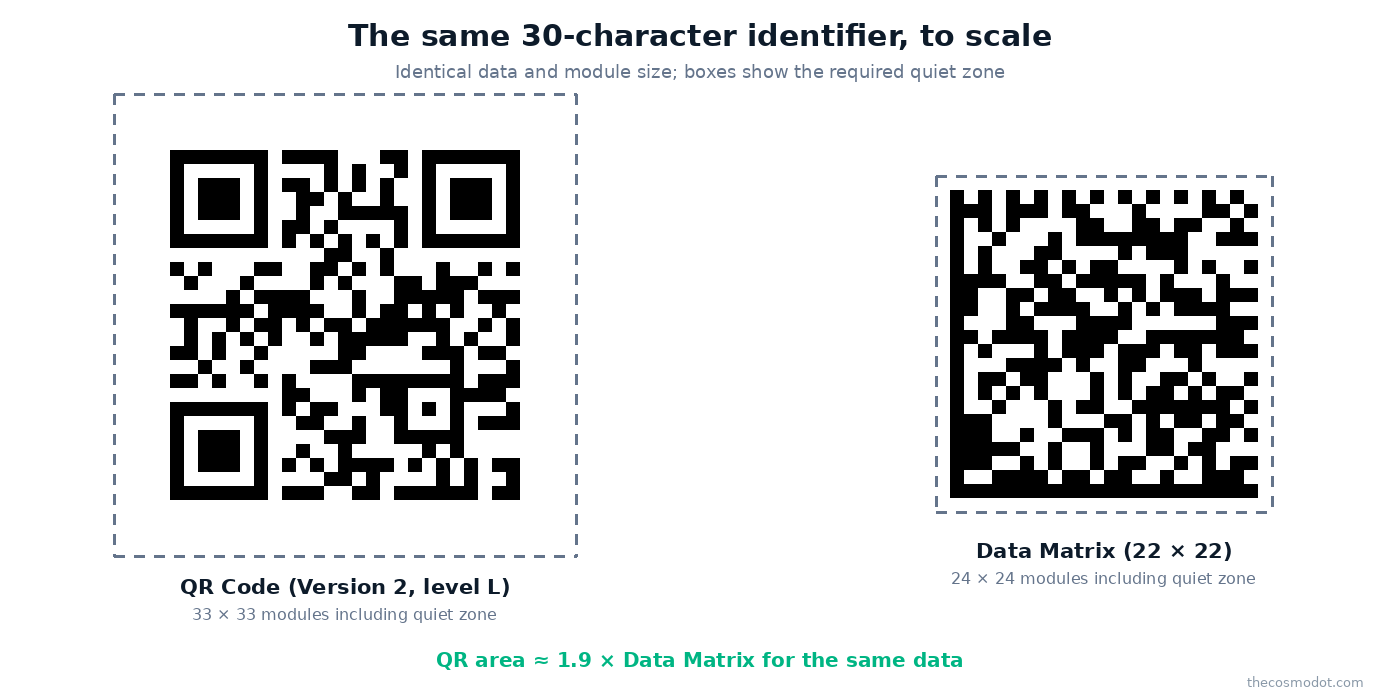
QR rows assume error-correction level L, the setting that minimizes QR symbol size; capacities are from the published version and format tables (Denso Wave). Across this range the QR symbol occupies between 1.7 and 2.1 times the area of the Data Matrix carrying the same data. At the small end the difference grows: the smallest Data Matrix is 10 × 10 modules, while the smallest standard QR is 21 × 21 plus four modules of quiet zone on each side. Micro QR (11 × 11 minimum, one finder) narrows the gap but holds at most 35 digits and is not supported by standard phone camera apps.
Error Correction
Both symbologies compute Reed – Solomon error-correction codewords over the data and use them to reconstruct modules lost to damage or obscuration. QR lets the generator set the strength; Data Matrix does not. QR offers four levels selected at generation — L, M, Q, and H, restoring approximately 7%, 15%, 25%, and 30% of codewords — and higher levels reduce capacity, so a QR generated for minimum size runs at level L with 7% recovery. Data Matrix has no selectable level: the error-correction share is fixed by the symbol format at roughly a quarter to a third of the codewords, and published recognition studies report Data Matrix symbols remaining readable with partial damage up to approximately 25% (Karrach & Pivarčiová, Management Systems in Production Engineering, 2020). For codes exposed to wear — parts, logistics labels — the fixed floor is an advantage; for a code printed large on packaging and scanned intact, level L is sufficient and the saved area can be spent on a larger module.
Scanning and Readability
On industrial equipment the two symbologies are equivalent to deploy: fixed-mount readers and handheld imagers decode both, with the active symbologies set in configuration. Verification is also common to both: printed symbols of either kind are graded under ISO/IEC 15415, direct part marks under ISO/IEC 29158, against the minimum grades the application standard sets. The grading parameters are described in our Data Matrix guide, and the cross-symbology context in the 2D barcode types guide.
Stock camera apps on iOS and Android read QR codes natively; GS1’s endorsement of QR for retail packaging cites this directly, describing QR as “the most widely used and ... read natively with smartphones” (GS1 global endorsement statement). Data Matrix is supported by the barcode frameworks on both platforms, but not by the stock camera experience, so reading one generally requires a dedicated scanning app. Where the intended reader is a consumer, this is usually the deciding factor.
Applications and Mandates
In most industries the choice between the two is already specified:
| Domain | Symbology | Specified by |
|---|---|---|
| Retail packaging and point of sale | QR with GS1 standards (GS1 Digital Link) | GS1 Sunrise 2027 program: adoption targeted by the end of 2027, with pilots in 48 countries |
| Healthcare and medical devices (UDI) | GS1 Data Matrix | FDA UDI rule / GS1 healthcare specifications |
| DoD item identification (IUID) | Data Matrix ECC 200 | MIL-STD-130 |
| Aerospace and automotive part marking | Data Matrix | SAE AS9132, ATA Spec 2000, AIAG B-17 |
| Payments, marketing, ticketing | QR | Market practice; phone-native reading |
| Electronics and small-component serialization | Data Matrix | Smallest reliable symbol per character |
Both GS1 choices were made by the same organization for different reading environments: QR for packaging scanned by consumers and point-of-sale equipment, GS1 Data Matrix for small, space-constrained healthcare items scanned by professional equipment (GS1 global endorsement statement).
Choosing Between Them
- Check the applicable specification first. Regulation, contract, or the customer’s drawing usually names the symbology; the table above covers the common cases.
- Identify the reader. If consumers scan the code with phones, QR. If the readers are imagers on a line, in a warehouse, or in a clinical setting, Data Matrix reads identically and occupies less space.
- Consider the surface. On labels and packaging, both print well at label cell sizes. On the part itself, the smaller symbol and one-module quiet zone favor Data Matrix, and the part-marking standards specify it.
Is There a Combined Option: Data Matrix and QR?
Programs that serve two reading environments — production equipment and consumer phones — have three options within the standard symbologies.
Dual marking. A QR for consumer information printed alongside a Data Matrix for production and logistics. This works, at the cost of label space and of maintaining two codes per item.
A single QR with GS1 Digital Link. GS1 Digital Link encodes the GS1 identifiers inside a web address — for example, a URI carrying the GTIN, lot, and serial number in its path — so one QR serves both the point of sale and the consumer’s browser (GS1 Digital Link URI syntax). This is the approach retail packaging is adopting under Sunrise 2027. It operates at the packaging level: it does not address identification of the part inside, and like every cell-based symbology, neither QR nor Data Matrix retains readability through manufacturing processes that transform the marked surface — heat treatment, blasting, and coating degrade the cell contrast and modulation that decoding and grading depend on.
A symbology with both capability sets on the part itself. The third option applies where the mark lives on the part itself: a symbology that carries Data Matrix-class data density on a small surface, is read by phones as well as industrial equipment, and remains readable through the manufacturing processes that follow marking. CDOT Code was developed for this case; the next section describes how it covers both sides.
Why CDOT Combines Data Matrix and QR Capabilities
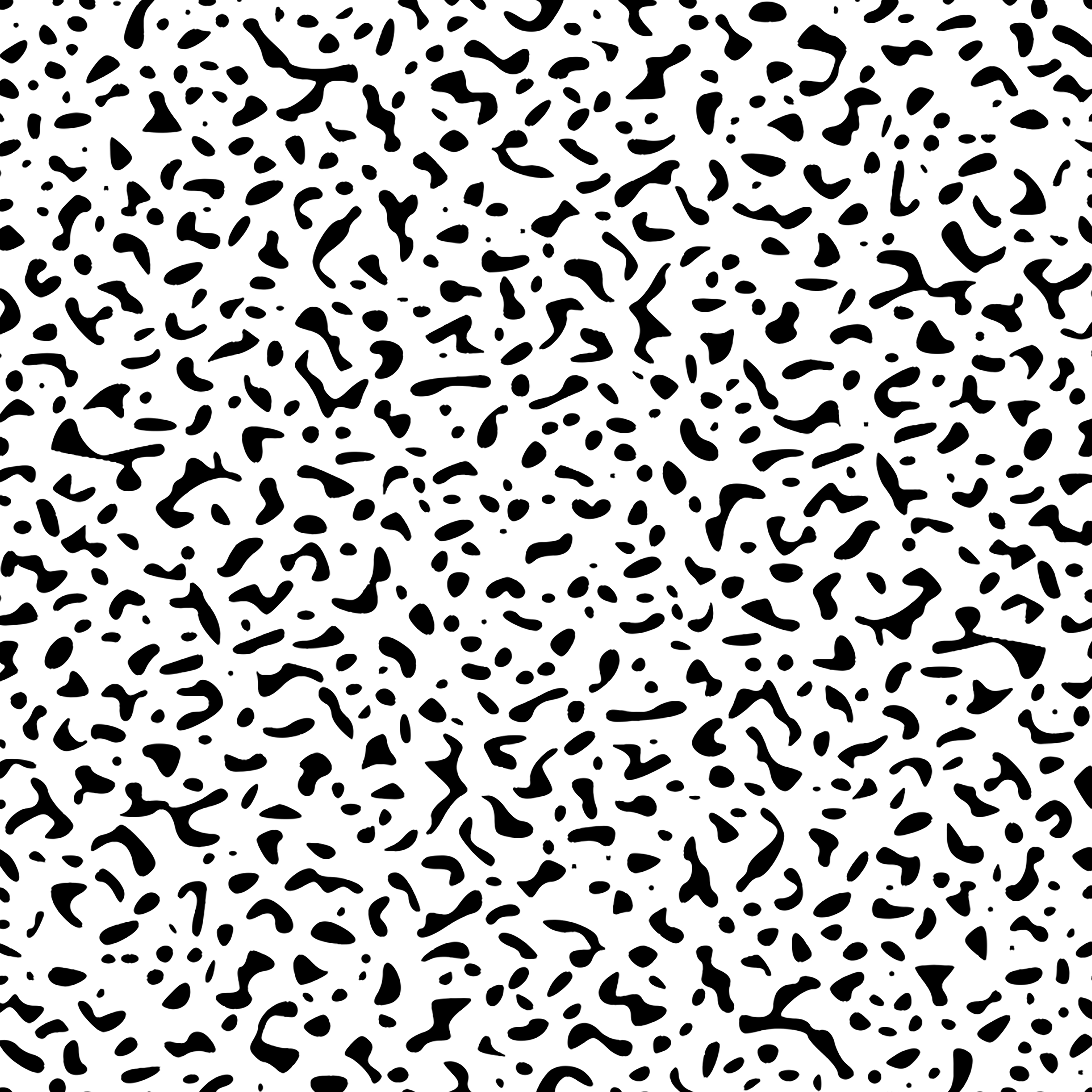
CDOT Code was developed for identification tasks that need the capabilities of both symbologies on the same mark: Data Matrix’s density and industrial role, QR’s accessibility to mobile devices, and a property neither has — readability through the manufacturing processes that follow marking.
The Data Matrix side: density and process survival
CDOT is built on a harmonic dot structure: the identifier is encoded in the frequency domain (U.S. Patent No. 12,242,922) across 62 reference points and decoded from the mark’s signal as a whole. Capacity does not depend on symbol size — up to 520 alphanumeric characters and more than 10¹³ unique identifiers within 3 mm², where a 14 × 14 Data Matrix of comparable size (2.67 mm at a 7.5 mil cell) holds ten alphanumeric characters. Because decoding reads the signal rather than individual cells, readability survives the processes that end cell-based marks: in production use, CDOT marks are read through 120 μm powder enameling and furnace curing at 850 °C (1,562 °F) on more than ten million appliance parts at a 99%+ read rate, through 2.5-hour heat treatment at 500 °C (932 °F) on EV battery housings across 13+ processes, through supplier-applied nickel plating on copper conductors, through shot blasting and multi-layer painting on armored-vehicle components, through primer and topcoat on aerospace structural parts, where the mark is applied as a very shallow surface trace, and in hot marking: aerospace alloy bars — high-performance steel, superalloy, and titanium — are marked on the saw-cut end face while still hot, at up to 900 °C (1,652 °F), replacing manual stamping and staying readable through multi-cycle heat treatment and heavy scale formation (Cosmodot customer case studies). Cell-based codes on parts also require periodic camera and illumination recalibration as surfaces vary; CDOT reading requires marking and camera setup once, with no recalibration cycle. The process-by-process selection logic is in our durable unique identifier guide.
The QR side: phone reading and opening links
What separates QR from Data Matrix in daily use is not only phone reading but what the scan returns: a QR can open a link. CDOT carries that capability onto the part. A CDOT mark is captured by phones and tablets as well as industrial readers, decoded through Cosmodot’s Fourier-transform signal analysis on an industrial PC, a virtual machine, or in the cloud — and the result is not limited to an alphanumeric string: the scan can return the part identifier to a line-side reader, or open the part’s record — production history, quality data, documentation — served through the CTRACE platform (Cosmodot — CDOT). At part level, this is the counterpart of what GS1 Digital Link provides at package level.
Error correction compared
QR restores up to approximately 30% of codewords at its highest setting, and Data Matrix recovers from partial damage on the order of a quarter to a third of the symbol; both stop decoding when damage exceeds what the Reed – Solomon codewords can reconstruct, because every surviving cell must still be classified as dark or light. CDOT’s redundancy works at the signal level: each frequency component carries the full identifier, so the decoder reconstructs and verifies the complete ID from as few as 3 – 4 intact reference points out of 62 — which is what permits reading at up to 90% physical surface loss, independent of contrast.
Closed decoding and counterfeit protection
QR and Data Matrix are open specifications by design: anyone can generate and decode them, which serves their purpose and also means a symbol can be copied or reproduced by anyone. CDOT decoding is performed only by Cosmodot’s signal analysis, and each mark carries a unique identifier from a space of more than 10¹³ — a mark cannot be generated or decoded outside the system, which makes the mark itself an authentication feature. In production, this is used for incoming validation of supplier-processed components, helping prevent unauthorized material substitution.
Frequently Asked Questions
- Is a Data Matrix smaller than a QR code for the same data?
- Yes. Including quiet zones at the same module size, a QR symbol occupies roughly 1.7 to 2.1 times the area of the Data Matrix carrying the same 20–50-character identifier. Data Matrix uses one module of quiet zone against QR's four, and reserves fewer modules for finder and format structures.
- Which has better error correction, QR or Data Matrix?
- Both use Reed–Solomon error correction. QR's level is selectable — approximately 7%, 15%, 25%, or 30% recovery, with higher levels reducing capacity — while Data Matrix fixes the share by format at roughly a quarter to a third of codewords. A QR generated for minimum size runs at the 7% level, below any Data Matrix format.
- Why does healthcare use Data Matrix while retail is moving to QR?
- Retail packaging is scanned by consumers and point-of-sale equipment, and phones read QR natively. Healthcare items are small and scanned by professional equipment, where GS1 Data Matrix's smaller footprint is the deciding factor, and the UDI infrastructure was built on it.
- Can a QR code be used for direct part marking?
- The specification does not prevent it, but the application standards for part marking — MIL-STD-130, SAE AS9132, AIAG B-17 — specify Data Matrix, and QR's four-module quiet zone and larger symbol work against it on small parts. Direct part marks of either symbology are graded under ISO/IEC 29158.
- What is replacing the retail barcode in 2027?
- GS1's Sunrise 2027 program: QR codes carrying GS1 standards (GS1 Digital Link), targeted for wide adoption at point of sale by the end of 2027, with pilots in 48 countries. The transition is gradual, and 1D barcodes continue alongside 2D during it.
- Do QR and Data Matrix need different scanners?
- No. Camera-based imagers decode both, and the active symbologies are a configuration setting. Phones are the exception: stock camera apps read QR natively, while Data Matrix generally requires a scanning app.
Prove CDOT on Your Parts
Validate CDOT under your own production conditions — your marking hardware, your parts, your processes, and your industrial readers.
Start a Technical Validation › Prefer email? Reach us at info@thecosmodot.comReferences
- Denso Wave — QR Code (history, versions, capacity): qrcode.com
- GS1 — Global Industry Endorsement Statement: QR Codes with GS1 Standards (Sunrise 2027): gs1.org
- GS1 — Digital Link URI Syntax standard: ref.gs1.org
- Keyence — What is a QR code? (versions, capacities): keyence.com
- ISO/IEC 18004 reference documentation (masking, format information, quiet zone): php-qrcode.readthedocs.io
- Karrach, L. & Pivarčiová, E. (2020) — Recognition of Data Matrix Codes in Images and Their Applications in Production Processes, Management Systems in Production Engineering 28(3): yadda.icm.edu.pl
- Cognex — ISO/IEC TR 29158 (AIM DPM) verification reference: cognex.com
- U.S. Patent 12,242,922: patents.google.com
- Cosmodot — What Is a Data Matrix Code?: thecosmodot.com
- Cosmodot — 2D Barcode Types: A Manufacturing Selection Guide: thecosmodot.com
- Cosmodot — What Is a Durable Unique Identifier? A Manufacturing Guide: thecosmodot.com
- Cosmodot — CDOT Code: thecosmodot.com/cdot